

Contents
Key findings
The start matters most
A training-free merge of the specialists already matches 200 MOPD updates from the base model.
Short MOPD recovers the rest
It improves every domain, most where the teacher still leads.
A simple recipe suffices
Uniform sampling and reverse KL match every alternative we compared, and beat Open-MOPD at 3.3× the speed.
Overview
Method
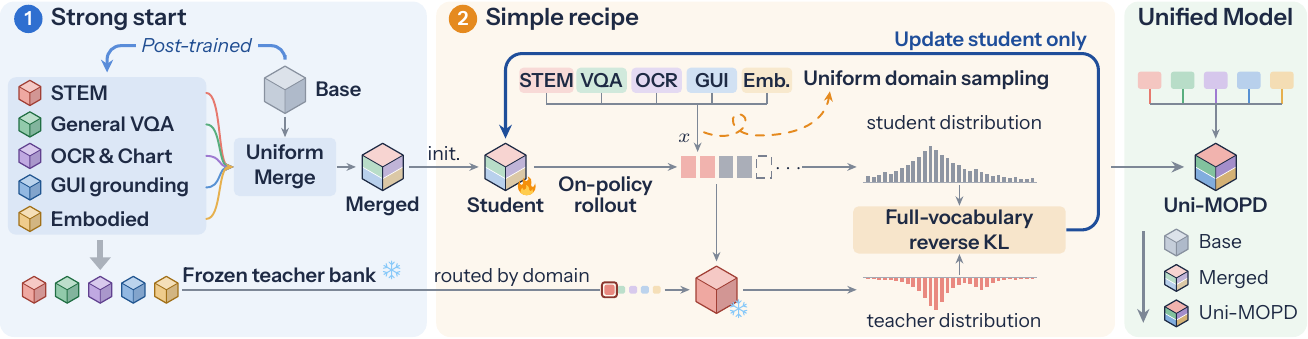
Strong start. Merge the specialists with equal weights: no search, no training. Simple recipe. The student answers queries from every domain; each domain's teacher supervises its own responses with full-vocabulary reverse KL for fifty updates.
1A strong start
A training-free merge starts where Base ends.
Before any distillation, a uniform merge of the specialists scores like the base model after 200 MOPD updates. After 50 updates the strong starts finish within 0.8 points of each other; the base model stays behind.
Average over 19 benchmarks; each line is a run from that start (the OCR specialist through update 50). Hover for values, click to hide a start.
2Short MOPD closes the gap
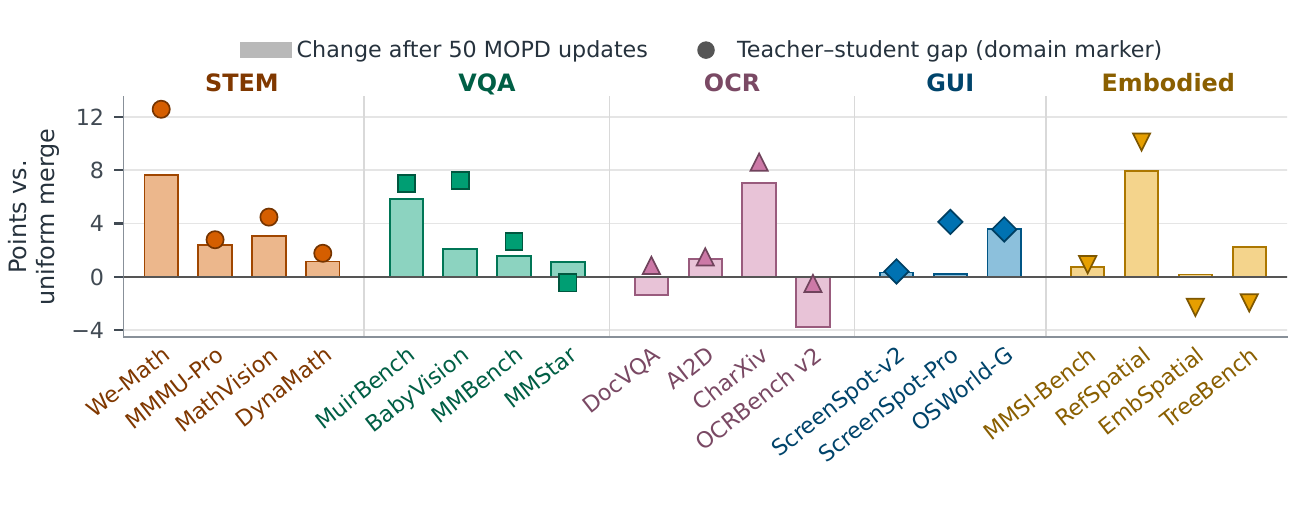
Distillation goes where the teacher still leads.
A merge plus 50 updates covers 92% of the way from Base to the best specialists, and the updates alone close 67% of what the merge leaves. Every domain improves, the gain on each benchmark follows how far the teacher still leads, and in embodied understanding the unified model ends above its own specialist.
3A simple recipe
From a strong start, plain choices are enough.
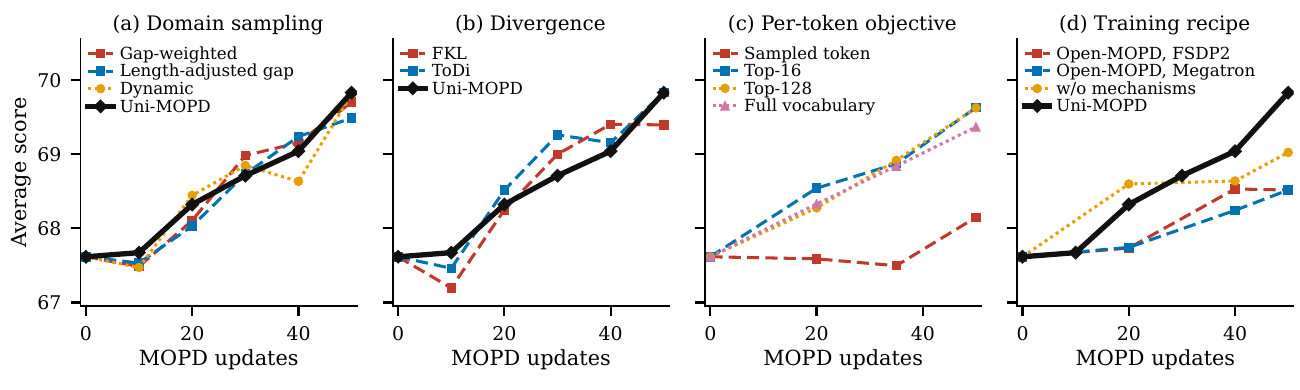
Uniform sampling and reverse KL match every alternative sampling strategy and divergence we compared. Supervising a distribution gains more than three times as much as a policy gradient on the sampled token.
4Stronger and faster than Open-MOPD
Under the same training budget, Uni-MOPD outperforms the Open-MOPD recipe and trains 3.3× faster.
Research notes
The detailed results behind the paper.
The starting point
Where should a multi-teacher distillation student start?
Every start, benchmark by benchmark: a training-free merge matches 200 updates from the base model.
Are merge coefficients worth tuning before distillation?
Tuning or calibrating the merge moves the starting score but not the endpoint; the total scale is what breaks it.
What distillation adds
The training recipe
What does the choice of distillation loss change?
Reverse KL, forward KL and ToDi differ by domain, and a distribution beats a sampled token.
How should MOPD sample queries across domains?
Equal query shares are not equal supervision: STEM carries most of the tokens.
Where does the Open-MOPD recipe lose ground, and what does the framework cost?
The Open-MOPD recipe stalls on STEM, and the framework runs full-vocabulary distillation at 266 s per update.
Quick start
Requires transformers>=4.57.1. To load a checkpoint downloaded from ModelScope, pass its local directory as model_id. GUI grounding uses a task-specific prompt; see the model card.
from transformers import AutoModelForImageTextToText, AutoProcessor

model_id = "AmberHeart/Uni-MOPD"
model = AutoModelForImageTextToText.from_pretrained(
    model_id, dtype="auto", device_map="auto"
)
processor = AutoProcessor.from_pretrained(model_id)

messages = [{
    "role": "user",
    "content": [
        {"type": "image", "image": "path-or-url-to-image"},
        {"type": "text", "text": "Describe this image."},
    ],
}]
inputs = processor.apply_chat_template(
    messages, tokenize=True, add_generation_prompt=True,
    return_dict=True, return_tensors="pt",
).to(model.device)
out = model.generate(**inputs, max_new_tokens=128)
print(processor.decode(out[0][inputs["input_ids"].shape[1]:], skip_special_tokens=True))
Citation
@misc{chang2026strongstartssimplerecipes,
  title         = {Strong Starts, Simple Recipes: Unified Multi-Teacher On-Policy Distillation from Multimodal Specialists},
  author        = {Wenzheng Chang and Taiqiang Wu and Yuqi Xu and Yongfu Zhu and Zelin Peng and Ji Zhao and Shuai Dong and Wenpu Liu and Caoyuan Ma and Xuehui Wang and Ziyue Wang and Weichu Xie and Haiyuan Wan and Ngai Wong and Tong He and Wenqi Shao and Jiaqi Wang},
  year          = {2026},
  eprint        = {2611.34397},
  archivePrefix = {arXiv},
  primaryClass  = {cs.LG},
  url           = {https://arxiv.org/abs/2611.34397}
}