Where does the Open-MOPD recipe lose ground, and what does the framework cost?
From the same merge, Uni-MOPD reaches 69.8 after 50 updates and the Open-MOPD recipe 68.5 to 69.0. The difference is concentrated in STEM, which the Open-MOPD runs leave near the merge, and in embodied understanding; they match or lead on GUI and VQA. The framework runs full-vocabulary distillation at 266 seconds per update.
Open-MOPD is the existing recipe for multi-teacher on-policy distillation. It supervises the student’s top 16 tokens with a clipped policy-gradient loss and adds three mechanisms that balance the training budget across domains: token-share balancing, gap weighting and reward refresh. We ran an adapted FSDP2 build of its released code from the same uniform merge, and reimplemented the recipe in our verl port with rollout routing replay, with and without the three mechanisms. All runs make 50 updates on the same queries in the same order. Uni-MOPD reaches 69.8; the FSDP2 build and the Megatron port with routing replay both reach 68.5, and the port without the mechanisms 69.0.
The gap is STEM and embodied understanding
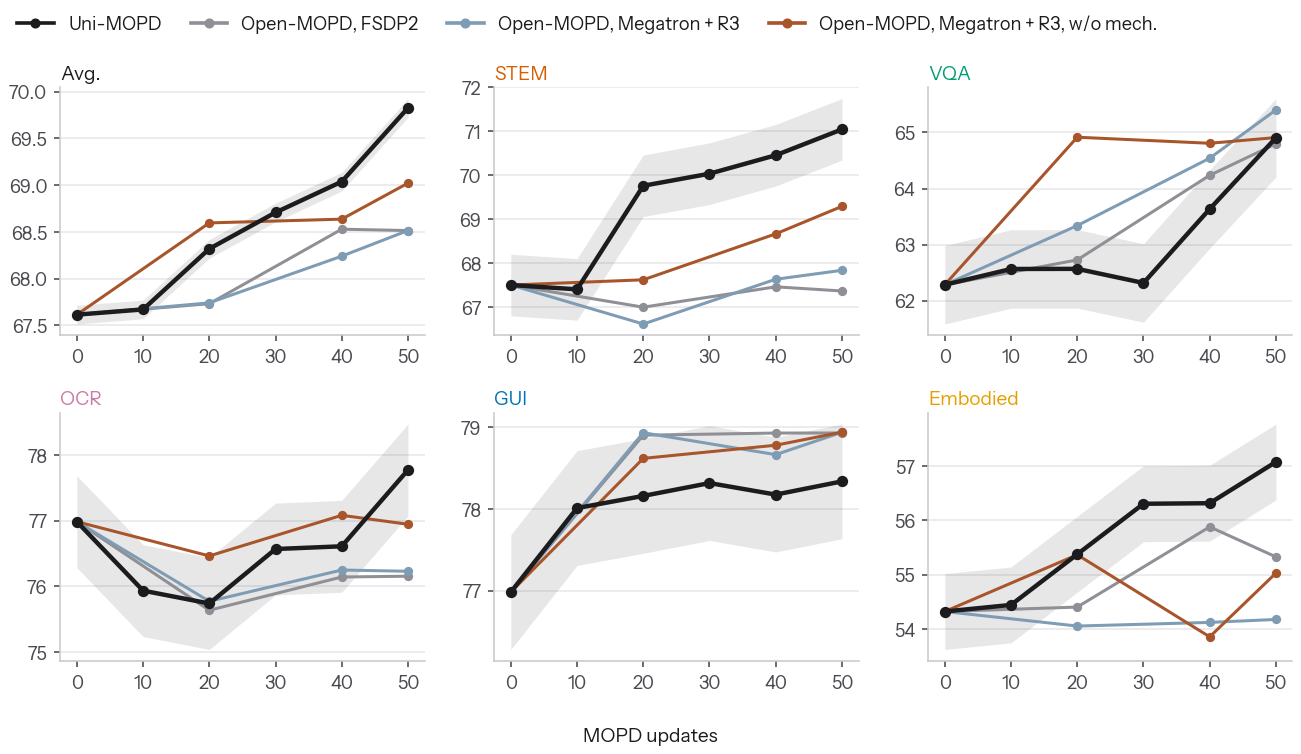
Domain means over the first 50 updates. Same start, same queries. The Open-MOPD runs were evaluated at updates 20, 40 and 50. Shading around the first series marks the re-evaluation variation (0.7 points per domain, 0.1 for the average).
| Domain mean at 50 updates | Uni-MOPD | Open-MOPD, FSDP2 | Open-MOPD, Megatron + R3 | w/o mechanisms |
|---|---|---|---|---|
| STEM | 71.0 | 67.4 | 67.8 | 69.3 |
| VQA | 64.9 | 64.8 | 65.4 | 64.9 |
| OCR | 77.8 | 76.2 | 76.2 | 76.9 |
| GUI | 78.3 | 78.9 | 78.9 | 78.9 |
| Embodied | 57.1 | 55.3 | 54.2 | 55.0 |
- STEM stays at the merge’s level. The merge scores 67.5. The two Open-MOPD runs with the mechanisms score 67.0 and 66.6 at update 20, 67.5 and 67.6 at update 40, and 67.4 and 67.8 at update 50, against 69.8, 70.5 and 71.0 for Uni-MOPD.
- Embodied understanding barely moves in the Megatron port (54.3 to 54.2) and gains 1.0 in the FSDP2 build, against 2.8 for Uni-MOPD.
- GUI and VQA are not where the gap is. All three Open-MOPD runs end 0.6 points above Uni-MOPD on GUI, and the Megatron port with routing replay ends 0.5 above on VQA.
Benchmark by benchmark
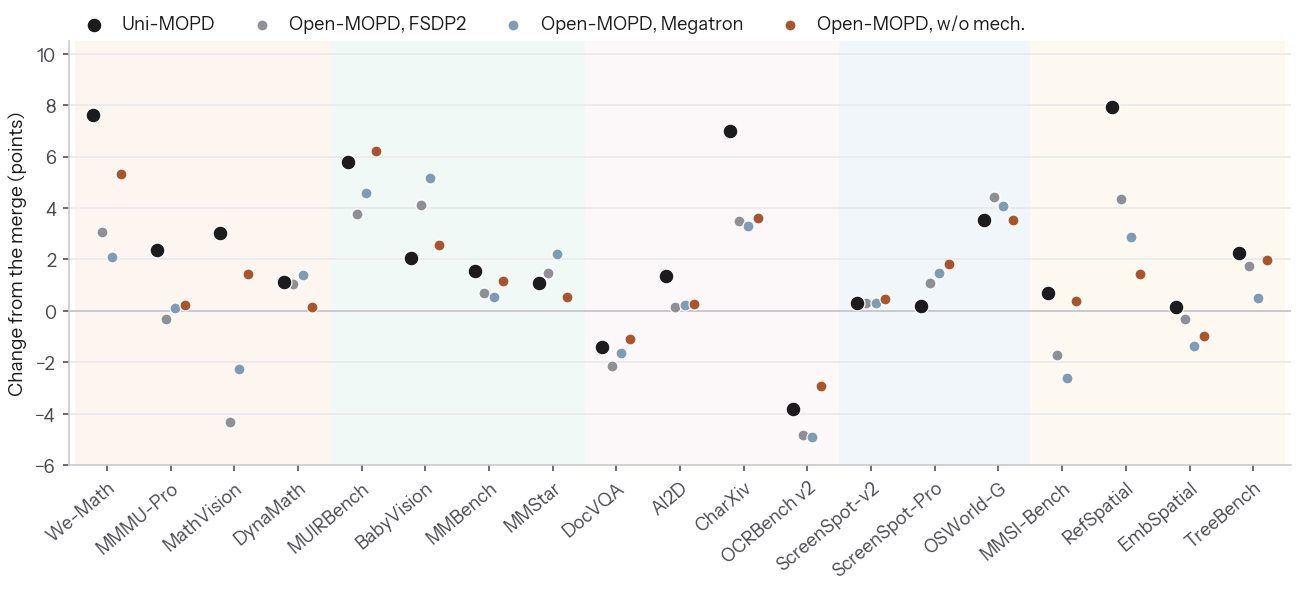
The STEM gap sits on the benchmarks where the STEM teacher leads. MathVision falls below the merge under the FSDP2 build (−4.3) and the Megatron port (−2.3) while Uni-MOPD gains 3.0, and We-Math gains 3.0 and 2.1 in those runs against 7.6. On the embodied side, RefSpatial gains 4.3 and 2.9 against 7.9, and MMSI-Bench falls by 1.7 and 2.6 where Uni-MOPD gains 0.7. In the other direction, the Open-MOPD runs gain more on BabyVision (4.1 and 5.2 against 2.1), OSWorld-G (4.4 and 4.1 against 3.5) and ScreenSpot-Pro (1.1 and 1.5 against 0.2). OCRBench v2 falls in every run, by 4.8 and 4.9 in the two with the mechanisms and 3.8 in Uni-MOPD.
Removing the three mechanisms moves the profile toward Uni-MOPD’s: MathVision turns from −2.3 to +1.4, We-Math from +2.1 to +5.3, and the STEM mean rises from 67.8 to 69.3. RefSpatial does not follow (+1.4).
A reading: equal token shares down-weight STEM
Token-share balancing reweights each domain’s loss so that every domain contributes an equal share of the batch’s response tokens. Under uniform sampling, STEM answers grow to about twenty times the length of GUI answers, and we observed STEM carry about 60% of the response tokens in our main run (see domain sampling). Holding every domain to a fifth of the tokens would cut STEM’s share to a third of that, so the domain whose long responses carry most of the learning signal is the one the recipe down-weights most, and the one that stays at the merge’s level. The run without the mechanisms recovers part of the STEM gain, consistent with this reading but not isolating token-share balancing from gap weighting and reward refresh.
Single seed per run, evaluated at updates 20, 40 and 50. The STEM and embodied differences between the FSDP2 build and Uni-MOPD (3.6 and 1.8 points) exceed the 0.7-point variation between evaluations of the same checkpoint.
More updates do not close the gap
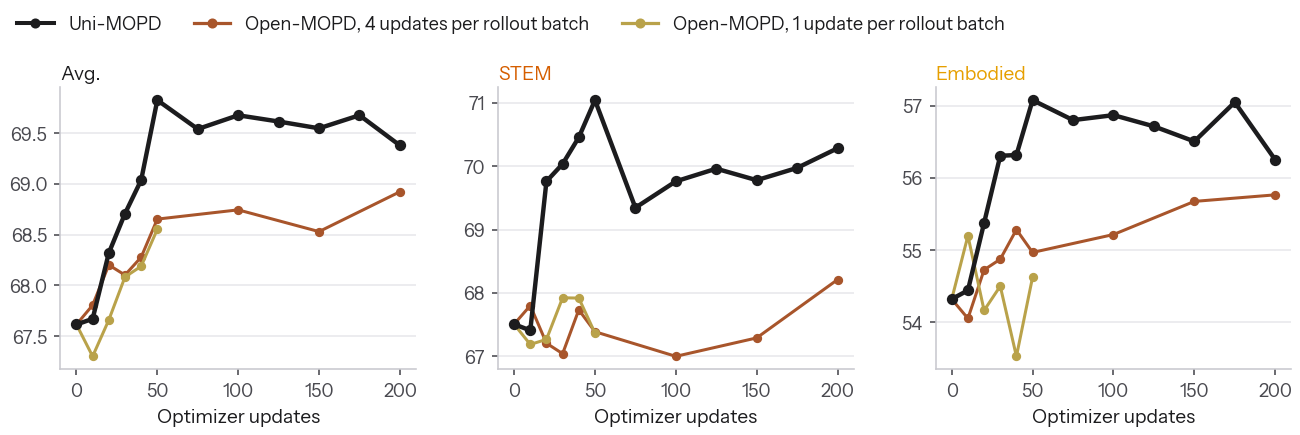
Continuing the Open-MOPD recipe to 200 updates. The Open-MOPD runs reuse each rollout batch for four updates or make one update per batch, and have no routing replay.
An earlier Open-MOPD run from the same merge reaches 68.7 at update 50 and 68.9 at update 200. Its STEM mean is 67.4 and then 68.2, and its embodied mean 55.0 and then 55.8, against 70.3 and 56.3 for Uni-MOPD at update 200. A run that makes one update per batch is level with it at update 50 (68.6). Four times the updates close part of the STEM gap and little of the rest.
The framework
Full-vocabulary distillation sounds expensive: five teachers, a mixture-of-experts student, and a full next-token distribution at every response position. In our framework one update takes 266 seconds on 24 H200 GPUs, 3.3× faster than the adapted FSDP2 build of the released Open-MOPD code on the same hardware and 2.3× faster than a verl implementation of the same loss.
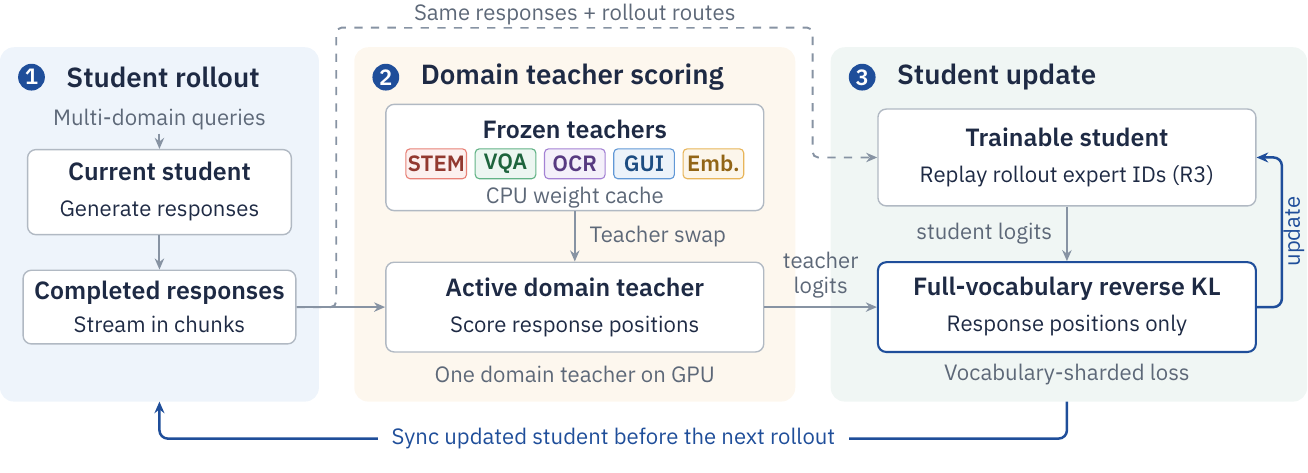
Training framework. Rollout, teacher scoring and the student update run as separate components.
The student writes responses, the frozen teacher of each query’s domain scores the same prefixes with its full next-token distribution, and the student minimizes reverse KL to it. Three ideas keep this affordable:
- Compute only what the loss uses. Logits exist only at response positions, and the loss is sharded and chunked over the vocabulary, so the full distribution is compared without ever materializing it at once.
- One teacher at a time. Teachers wait in CPU memory and are swapped onto the GPUs when their domain comes up, so five 30B-parameter teachers never have to be resident together.
- Overlap generation and scoring. Finished responses stream into teacher scoring while long ones are still being generated, and the update waits for the whole batch, so every response in it comes from the same policy.
For the mixture-of-experts student, rollout routing replay makes training use the same experts that generation chose for each token. In a typical update, generation takes about 60% of the wall-clock time and teacher scoring a little over a third, with the phases overlapping. The rollouts, not the full distribution, set the pace, so truncating the supervision saves little time.
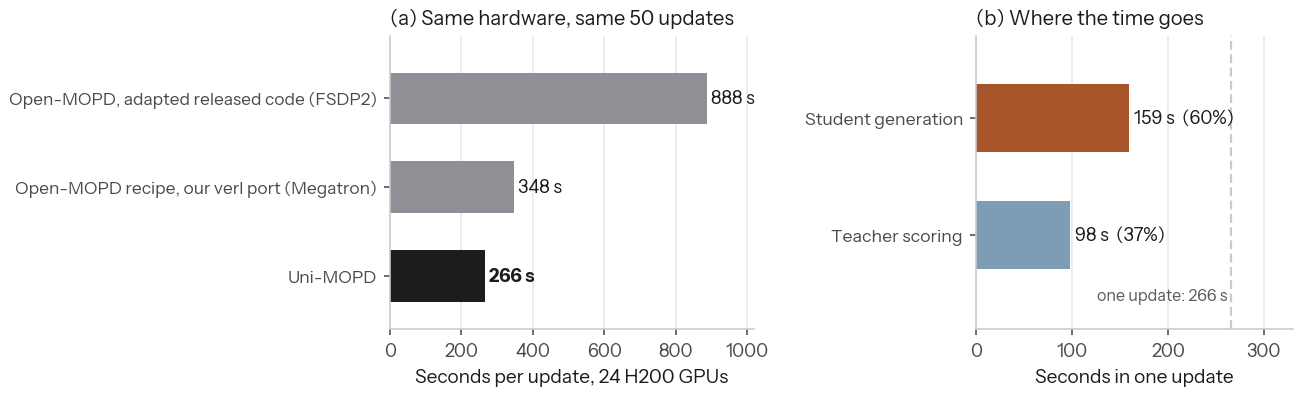
Seconds per update. (a) Uni-MOPD against the Open-MOPD implementations: 89, 116 and 296 H200 GPU-hours for 50 updates. (b) The two phases overlap within one update.
The speedup covers the complete training implementations, including their execution backends. Fifty updates, the budget behind the main results, take under four hours.
Release
The training framework, the five specialists and the unified student are released with the paper; the links are on the project page.
In practice
- Check per-domain curves, not only the average: a recipe that matches on GUI and VQA can leave STEM untouched.
- Be careful with a loss reweighting that equalizes tokens across domains when answer lengths differ by an order of magnitude.
- Compare recipes at a matched update count and report what each update costs.